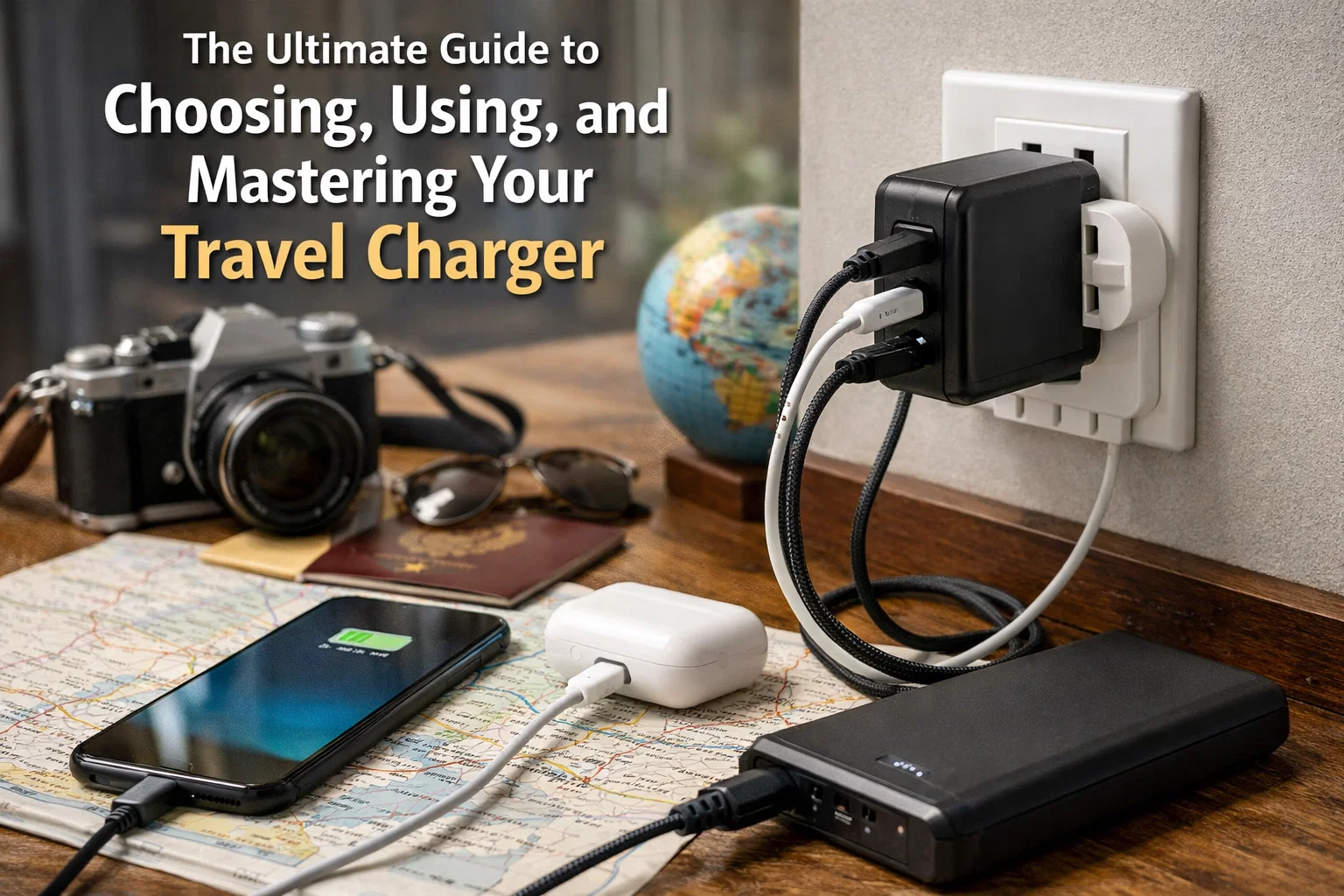
An Executive Summary
In an era of constant connectivity, a reliable travel charger is no longer a mere accessory but a critical piece of modern travel gear. This comprehensive guide moves beyond basic buying advice to explore the technical, practical, and strategic aspects of travel power. We will dissect specifications, demystify global charging standards, and provide expert insights into optimizing your charging setup for every conceivable journey. From the solo backpacker to the business executive, this guide serves as your definitive resource for ensuring your devices remain powered, safe, and ready wherever your travels take you.
Introduction: The Unseen Travel Essential
Imagine landing after a long international flight, ready to hail a rideshare or navigate to your hotel, only to find your phone’s battery dead. This common, anxiety-inducing scenario underscores the profound importance of a well-chosen travel charger. More than just a plug and a cable, a modern travel charger is a sophisticated piece of electrical engineering designed to bridge the gap between the world’s disparate power grids and our growing collection of essential devices. It is the silent guardian of our digital lives on the road. Selecting the right one requires understanding power delivery, portability, compatibility, and safety—topics we will explore in depth. This guide is crafted to transform you from a casual buyer into an informed user, capable of making empowered decisions that enhance your travel experience and keep you connected from departure to return.
Understanding the Anatomy of a Modern Travel Charger
At its core, a travel charger converts alternating current (AC) from a wall outlet into the direct current (DC) that your devices need to charge their batteries. However, the sophistication lies in the details. Key components include the plug adapter, which physically interfaces with the outlet type (like US Type A or EU Type C), and the internal power converter. Modern units integrate Gallium Nitride (GaN) technology, which allows for more efficient power conversion in a significantly smaller and cooler package compared to older silicon-based designs.
Beyond the plug, the charger’s ports and their capabilities define its utility. USB-A ports are legacy but still useful for older gadgets. USB-C, however, is the universal standard for new devices, capable of handling much higher power levels through protocols like USB Power Delivery (PD). The wattage rating, such as 65W or 100W, indicates the total power output. A higher wattage doesn’t just mean faster charging; it means the ability to power-hungry devices like laptops while simultaneously charging other gear. Understanding this anatomy is the first step to choosing a charger that won’t become obsolete.
Key Takeaway: A high-quality travel charger is a fusion of robust physical adapters and intelligent internal electronics, with USB-C Power Delivery and GaN technology being hallmarks of a modern, efficient design.
Navigating Global Power Standards: Voltage, Plugs, and Frequency
A critical and often confusing aspect of travel charging is the world’s lack of a unified electrical standard. Mismatches here can, at best, prevent charging and, at worst, damage your charger or device. The two primary variables are voltage and plug physical shape. Countries operate on either 110-120V (like North America and Japan) or 220-240V (like most of Europe, Asia, and Africa). Modern switching power supplies, found in quality laptop chargers and universal travel adapters, are designed to accept this full range (often labeled “100-240V, 50/60Hz”).
The shape of the plug, however, is not auto-adapting. There are over 15 different outlet types globally. A comprehensive travel charger will either come with a set of interchangeable plug heads or a single, multi-pin “universal” plug that can physically fit into the most common socket types. It’s vital to research your destination’s outlet style. Relying on a cheap, non-certified physical adapter can pose a safety risk due to poor electrical contact or lack of surge protection.
Key Takeaway: Always ensure your travel charger and devices are compatible with your destination’s voltage (look for “100-240V” input) and that you have the correct physical plug adapter for the wall socket.
Defining the Ideal Travel Charger
An ideal travel charger is a compact, lightweight power adapter that safely converts local mains electricity for use with portable electronic devices anywhere in the world. It typically features universal voltage compatibility (100-240V), interchangeable plug adapters for global use, and multiple high-speed output ports like USB-C with Power Delivery. Its core function is to provide reliable, efficient, and safe power conversion while minimizing bulk in a traveler’s bag, serving as a single charging solution for phones, tablets, and often even laptops.
Charging Speed Decoded: Watts, Amps, Volts, and Protocols
Charging speed is not a mystery; it’s a simple equation: Watts (Power) = Volts (Pressure) x Amps (Current). A higher wattage charger can deliver more power, leading to faster charging, if your device can accept it. This is where communication protocols become essential. Basic USB chargers provide a fixed 5V output. Smart protocols like USB Power Delivery (PD) and Qualcomm Quick Charge (QC) allow the charger and device to negotiate a higher voltage (e.g., 9V, 12V, 15V, or even 20V) and current to safely maximize the wattage delivered.
For example, a phone might support 18W PD charging, while a modern laptop may require 65W PD. Using a 30W PD charger on that laptop would likely charge it slowly or only maintain its battery during use. Always match your charger’s maximum PD output to the needs of your most power-hungry device. For a mixed-device setup, a multi-port charger’s total wattage is shared, so a 65W charger with two ports might deliver 45W to a laptop and 18W to a phone when both are plugged in.
Key Takeaway: True fast charging requires both a high-wattage charger and a compatible device that supports a smart protocol like USB Power Delivery; always check your device’s specifications.
Portability vs. Power: Striking the Perfect Balance
This is the fundamental dilemma for every traveler. A tiny 20W single-port charger is supremely portable but inadequate for a professional needing to charge a laptop, tablet, and phone overnight. Conversely, bringing your laptop’s original 96W brick plus a separate phone charger creates bulk and clutter. The goal is to find the minimum viable charger that meets all your power needs without excess weight.
GaN technology is the game-changer here, enabling chargers with high power output (65W to 100W+) in a form factor not much larger than old 30W models. For most travelers, a 65W GaN charger with two USB-C ports and one USB-A port represents a sweet spot. It can charge a laptop at full speed or power three devices simultaneously at good speeds, all in a package that fits in a jacket pocket. Consider your daily device roster and choose a travel charger with just enough ports and total wattage to cover your scenario.
Key Takeaway: Leverage GaN technology to find a charger that offers the maximum power and port count for your essential devices in the smallest, lightest possible form factor.
Safety and Reliability: Non-Negotiable Features
When dealing with electricity, especially in regions with unstable grids, safety cannot be an afterthought. A trustworthy travel charger must have built-in protections. Look for certifications from recognized international bodies like UL (USA), CE (Europe), or PSE (Japan). These indicate the unit has passed rigorous safety tests. Essential protections include surge protection (to guard against voltage spikes), over-current protection (to prevent circuit overload), over-temperature protection (to shut down if overheating), and short-circuit protection.
Reliability is equally crucial. A charger that fails mid-trip is a major inconvenience. This is where build quality and brand reputation matter. Chargers with sturdy, well-fitting plug attachments, robust casings, and high-quality internal components from reputable manufacturers are worth the investment. Avoid no-name chargers from dubious sources, as they often cut corners on safety components and insulation, posing a real fire or electrocution hazard.
Key Takeaway: Never compromise on safety; insist on certified travel chargers from reputable brands that include core electrical protections, ensuring both your devices and your personal safety are guarded.
The One-Charger Solution: Powering Laptops, Phones, and Tablets
The dream of carrying one charger for all devices is now a reality. The unifying standard is USB-C Power Delivery. Most modern laptops, from ultraportables to some professional models, can charge via USB-C PD. A 65W or 100W GaN PD charger can power such a laptop effectively. Since phones and tablets also charge via USB-C (or USB-A with a cable), a single multi-port travel charger becomes your all-in-one power station.
The practical benefit is immense. It reduces cable clutter, ensures you always have the right charger for any device, and simplifies packing. For instance, a photographer on assignment could use a single 100W charger to power their laptop for photo editing, their camera battery via a USB-C dock, and their phone and headlamp simultaneously at the hotel. This consolidated approach is the pinnacle of efficient travel gear management.
Key Takeaway: By adopting a high-wattage USB-C Power Delivery travel charger, you can consolidate power for nearly all your electronics, eliminating the need to carry multiple proprietary power bricks.
Cables Matter: The Unsung Heroes of Your Charging Kit
The best travel charger is hamstrung by a poor-quality cable. Cables are not just dumb wires; they contain tiny chips that handle the communication for fast-charging protocols and manage power flow. A subpar cable can limit charging speed, fail to trigger fast-charging modes, or even break internally, becoming a fire risk. For USB-C PD charging, ensure your cables are certified and capable of handling the wattage you need. A cable rated for 60W may not work properly with a 100W charger and laptop.
Durability is key for travel. Look for cables with reinforced connectors (often with a braided nylon jacket) that can withstand repeated bending and being stuffed into bags. Consider length as well; a short 1-foot cable is great for portability, but a 3-foot or 6-foot cable offers flexibility when the outlet is far from your bed or seat. Pack at least two: one dedicated to your primary device (phone) and another as a backup or for other gear.
Key Takeaway: Invest in durable, certified cables rated for the appropriate wattage; they are critical for ensuring safety, achieving maximum charging speeds, and maintaining reliability on the road.
Smart Packing: Integrating Your Charger into Your Travel System
Your travel charger shouldn’t be an afterthought tossed into your bag. Integrate it into a organized system. Use a small cable organizer or pouch to keep your charger, all necessary plug adapters, and cables together. This prevents “cord spaghetti” and ensures you can quickly find everything. Always pack your primary charger and a cable in your personal item or carry-on, not checked luggage. You may need it during a layover or if your checked bag is delayed.
For multi-country trips, only pack the specific interchangeable plug heads you’ll need. Some chargers have clever designs where the plugs fold or slide into the body, making them even more packable. Furthermore, consider the charger’s physical design. A compact, flat profile is easier to pack than a large cube, especially for tight outlet spaces in airports or older hotels.
Key Takeaway: Treat your charger, cables, and adapters as a single, organized kit stored in your carry-on for easy access and to avoid lost charging capability.
Airports, Planes, and Hotels: Charging in Transit
The travel environment presents unique charging challenges. Airport outlets are often scarce and awkwardly placed. A compact charger with a short, integrated cable or a very short “outlet nub” charger can be invaluable for claiming space in crowded terminal charging stations. Many modern planes now have USB-A or even USB-C seatback ports. However, these are often limited to low power (5V/1A or less), suitable only for slow battery maintenance. For faster in-flight charging, you’ll need a portable power bank plugged into the seat’s USB port or, better yet, an AC power port if available in premium cabins.
Hotels vary widely. International chains often have universal outlets or provide adapters, but many smaller hotels or rentals do not. Always be prepared with your own adapter. Furthermore, hotel room outlets are famously scarce. Packing a small, portable multi-outlet surge protector or a USB hub can turn one outlet into several, allowing you to charge all your devices from your single travel charger overnight.
Key Takeaway: Transit spaces demand versatility; a compact charger, a capable power bank, and a small outlet expander can solve most in-transit and accommodation-based charging dilemmas.
The Rise of the Power Bank: Your Travel Charger’s Best Friend
While not a replacement for a wall charger, a high-capacity power bank is its essential companion. It provides power independence when you’re away from outlets for extended periods—on long bus rides, hiking trips, or during prolonged airport delays. The capacity is measured in milliampere-hours (mAh). For reference, a 10,000mAh bank can charge a typical smartphone 2-3 times, while a 20,000mAh bank can charge a laptop once in addition to phones.
Look for power banks with USB-C Power Delivery for bidirectional fast charging. This means they can be recharged quickly by your travel charger and can fast-charge your compatible devices. Some premium power banks even function as a compact travel charger themselves when plugged into the wall, serving a dual purpose. As with chargers, safety certifications and quality cells from brands like Samsung or LG are non-negotiable for reliability and safety.
Key Takeaway: A high-capacity, PD-enabled power bank complements your travel charger by providing essential mobile power, ensuring your devices stay alive through long days of exploration or unreliable power access.
Common Mistakes and How to Avoid Them
Even seasoned travelers make charging errors. A frequent mistake is assuming all USB ports deliver the same power. The slow-charging USB port on a hotel alarm clock or airport seatback will barely maintain your phone’s battery. Always use your own high-output charger when possible. Another error is using the wrong cable for fast charging, leading to frustration when a device charges slowly despite a powerful charger.
Perhaps the most significant mistake is purchasing based on price alone. Extremely cheap, unbranded chargers and cables from online marketplaces frequently lack proper safety isolation, surge protection, and accurate voltage regulation. They risk damaging your expensive electronics and pose a safety hazard. As one industry electrical safety consultant notes, “The cost savings on a counterfeit charger are erased a thousand times over by the potential cost of a fried device or, worse, an electrical fire.” Invest in quality from the start.
Key Takeaway: Avoid slow charging and safety risks by using your own high-quality charger and certified cables, and never prioritize low cost over proven safety and performance.
Future-Proofing Your Purchase: Trends to Watch
The travel charger market continues to evolve. Wireless charging, while convenient at home, remains less practical for travel due to slower speeds and the need to keep the device on a pad. However, the integration of wireless charging pads into power banks is a growing trend for on-the-go top-ups. More impactful is the move towards even higher power densities with GaN technology, allowing for 120W+ chargers in incredibly small sizes.
Another trend is the standardization around USB-C. With the EU mandating USB-C as a common charger for many electronics, the future is one of true universality. We may soon see travel chargers that are little more than a global plug adapter with a high-power USB-C port, and every device will come with a USB-C cable. Furthermore, smart features like digital displays showing power draw and thermal management are beginning to appear on premium models.
Key Takeaway: To future-proof, prioritize USB-C Power Delivery and GaN technology, as these are the foundations upon which faster, smaller, and more universal charging solutions are being built.
Real-World Application: A Photographer’s Charging Strategy
Consider a travel photographer embarking on a two-week landscape trip through Scotland. Their gear includes a mirrorless camera (USB-C charging), two camera batteries (charged via a dedicated dock that uses USB-C), a powerful laptop for editing (USB-C PD, 65W), a smartphone, a headlamp, and a drone. Their charging kit is ruthlessly efficient: a single 100W GaN travel charger with two USB-C and one USB-A port, a set of UK plug adapters, and a 20,000mAh PD power bank. Each night at a lodges, the 100W charger powers the laptop and simultaneously tops up the camera battery dock and power bank. The power bank lives in the daypack, providing all-day phone power and emergency top-ups for the camera during long hikes away from the car. This setup, centered on one powerful travel charger, covers all high-wattage needs while the power bank handles mobility, proving that a strategic approach beats carrying a bag full of individual chargers.
Comparative Insights: Charger Types at a Glance
| Charger Type | Typical Wattage | Best For | Key Advantages | Limitations |
|---|---|---|---|---|
| Basic Single-Port | 5W – 20W | Ultra-light travel, backup charger. | Minimal size/weight, very low cost. | Slow charging, single device only. |
| Multi-Port USB-A | 30W – 50W | Families with older devices, multiple phones/tablets. | Multiple simultaneous charges, affordable. | Lacks USB-C PD for fast laptop charging. |
| GaN Multi-Port (USB-C Focused) | 65W – 100W+ | Professionals, digital nomads, power users. | High-speed laptop charging, multiple fast ports, compact size. | Higher initial cost. |
| All-in-One World Adapter w/ USB | 15W – 40W | Casual international tourists. | Built-in global plugs, decent portability. | Often lower total wattage, slower charging speeds. |
| Desktop/USB Hub Charger | 100W+ | Long-term travel, remote work setups. | High port count (4-6+), powerful for many devices. | Large size, not portable for day trips. |
The Travel Charger Checklist: Before Your Next Trip
Use this actionable list to audit your charging setup before departure:
- [ ] Verify your travel charger’s input voltage covers 100-240V.
- [ ] Confirm you have the correct physical plug adapters for your destination(s).
- [ ] Ensure your charger’s maximum wattage meets or exceeds your most power-hungry device’s requirement (e.g., laptop).
- [ ] Check that all cables are certified and in good condition, with no fraying or loose connectors.
- [ ] Pack a high-capacity power bank (20,000mAh recommended for long days) with USB-C PD.
- [ ] Organize all components (charger, adapters, cables, power bank) into a dedicated pouch in your carry-on.
- [ ] Consider adding a compact, plug-in multi-outlet to overcome limited hotel sockets.
- [ ] Test your entire setup at home with all devices to ensure compatibility and speed.
Conclusion: Empowering Your Journeys
A travel charger is a profound example of how a small, often overlooked tool can have an outsized impact on your travel experience. It is the linchpin of your digital connectivity, your link to navigation, communication, photography, and entertainment. By moving beyond the basics to understand the principles of power delivery, global compatibility, and strategic integration, you empower yourself to travel more smoothly and with greater confidence. The ideal travel charger is not necessarily the most powerful or the cheapest, but the one that most intelligently balances power, portability, and safety for your unique travel style. Invest thoughtfully in this essential gear, and you’ll never again face the anxiety of a dying device in a foreign place. Your adventures deserve nothing less than reliable, safe, and efficient power from start to finish.
Frequently Asked Questions (FAQ)
What is the difference between a travel adapter and a travel charger?
A travel adapter is a simple passive device that only changes the physical plug shape to fit different wall outlets; it does not convert electricity. A travel charger is an active device (often with built-in adapters) that converts the local AC power to the DC power your devices need, frequently with multiple USB ports for fast charging. For modern electronics, you need a charger, not just an adapter.
Can I use my travel charger in any country?
You can use a quality travel charger in any country, provided it has two key features: universal voltage input (labeled 100-240V, 50/60Hz) and the correct physical plug attachment or adapter for that country’s wall outlets. Most modern chargers have the voltage range covered, so securing the right plug is the primary concern.
How many watts do I need in a travel charger for my laptop?
Check your laptop’s power requirements, usually found on its original charger brick (e.g., “65W”). For reliable charging, especially while in use, your travel charger should match or exceed this wattage. A 65W USB-C PD charger suits most ultraportables, while creative pro or gaming laptops may require 100W or more for optimal performance.
Is it safe to leave my travel charger plugged in overnight?
Yes, it is generally safe to leave a certified, high-quality travel charger plugged in overnight. These devices are designed with safety cut-offs for over-temperature and over-current. However, for general electrical safety and minimal energy waste, it’s a good practice to unplug any charger when not in use for extended periods or if you leave your accommodation.
Why is my device charging slowly with my travel charger?
Slow charging typically results from a mismatch in capability. The outlet may be low-power, you might be using a low-wattage port on a multi-port charger, the cable may not support fast-charging protocols, or your device may not be compatible with the charger’s high-speed standard (like PD). Ensure all components—outlet, travel charger, cable, and device—are aligned for fast charging.