The Complete Authority Guide to Choosing and Using Your Foldable Travel Bag
Let’s be honest. The space between trips is often dominated by a bulky, empty suitcase hogging precious closet real estate. There’s a smarter, more liberated way to travel. Enter the foldable travel bag, a deceptively simple piece of gear that has evolved from a basic nylon sack into a cornerstone of modern, efficient travel. This guide explains not just what a foldable bag is, but how to integrate it into your travel philosophy to solve practical problems, reduce stress, and unlock new flexibility. This resource helps readers make an expert-level choice and utilize their bag to its fullest potential, moving beyond basic product lists to strategic mastery.
Whether you’re a minimalist backpacker, a savvy souvenir hunter, a business traveler needing a contingency plan, or someone simply tired of overpacking, a well-chosen foldable bag is your secret weapon. We will dissect its anatomy, explore its myriad applications, and provide the nuanced understanding needed to select the perfect companion for your journeys. This isn’t about adding another bag; it’s about fundamentally changing how you pack and travel.
Understanding the Foldable Travel Bag: More Than Just a Spare Sack
At its core, a foldable travel bag is a piece of luggage designed for extreme compressibility and storage when not in use. Unlike a rigid suitcase or a structured backpack, its primary virtue is its ability to transform from a functional carrying vessel into a compact pouch or flat panel that can be tucked into a corner of your main luggage. This simple capability belies profound utility. The modern iteration isn’t just a “just-in-case” item; it’s a strategic tool for adaptive travel.
From a historical perspective, the concept is ancient—think of rolled-up animal hides or cloth sacks. The modern travel version, however, emerged with the proliferation of lightweight, durable synthetic fabrics like nylon and polyester. Early versions were often flimsy, single-compartment duffels. Today, the category encompasses a vast spectrum, from ultra-lightweight zip pouches for market finds to robust, feature-packed backpacks that can serve as a primary daypack. The evolution mirrors a shift in traveler behavior: from linear, single-destination trips to multi-city itineraries, adventure layovers, and a growing desire to bring meaningful items home without the hassle of checking an extra bag.
What is a foldable travel bag?
A foldable travel bag is a highly portable, compressible piece of auxiliary luggage designed for storage within your main baggage when empty. Constructed from lightweight, durable materials like nylon or polyester, it deploys to provide extra carrying capacity for souvenirs, laundry, or gear separation during a trip. Its defining characteristic is its ability to reduce to a fraction of its deployed size for effortless transport.
The Strategic Advantages: Solving Real Traveler Problems
The value of a foldable bag becomes crystal clear when faced with common, frustrating travel scenarios. It’s a solution-oriented piece of gear that addresses several key pain points with elegant simplicity.
Problem 1: The Souvenir Dilemma. You’ve embarked on a two-week tour with a perfectly packed carry-on suitcase. Midway through, you discover a local artisan market or a must-have item that won’t fit into your existing luggage. The old choices were grim: ship it home at exorbitant cost, awkwardly carry it onto the plane, or worse, buy a cheap, bulky duffel at the airport and potentially face checked baggage fees. A foldable travel bag stored in your suitcase elegantly solves this. When your return cargo expands, you simply deploy your spare bag. You can check your now-full primary suitcase (if needed) and use the foldable as your new, lightweight carry-on for essentials, or vice-versa. It turns a moment of stress into one of prepared satisfaction.
Problem 2: The Multi-Destination Packing Puzzle. Traveling from a city to a beach, then to the mountains? Each environment requires different gear. Instead of living out of a chaotic, monolithic suitcase, you can use your foldable bag as a modular packing pod. Pack all your hiking clothes and gear in the foldable, stored inside your main bag. Upon reaching the trailhead, extract the foldable backpack, and it’s instantly your trail-ready pack. Your main suitcase, now lighter and containing just your city wear, can be left securely at your lodge. This modular approach keeps you organized and adapts your luggage to the phase of your journey.
Problem 3: The “Just in Case” Overpacker’s Paradox. Many travelers overpack their primary bag “just in case,” leading to heavy, unwieldy luggage. A foldable bag flips this logic. By packing a foldable duffel or tote, you give yourself a literal safety net for overflow. This allows you to pack your primary bag more minimally and confidently, knowing that if you acquire something or need to separate dirty laundry, you have a dedicated, planned space for it. It psychologically permits smarter, lighter initial packing.
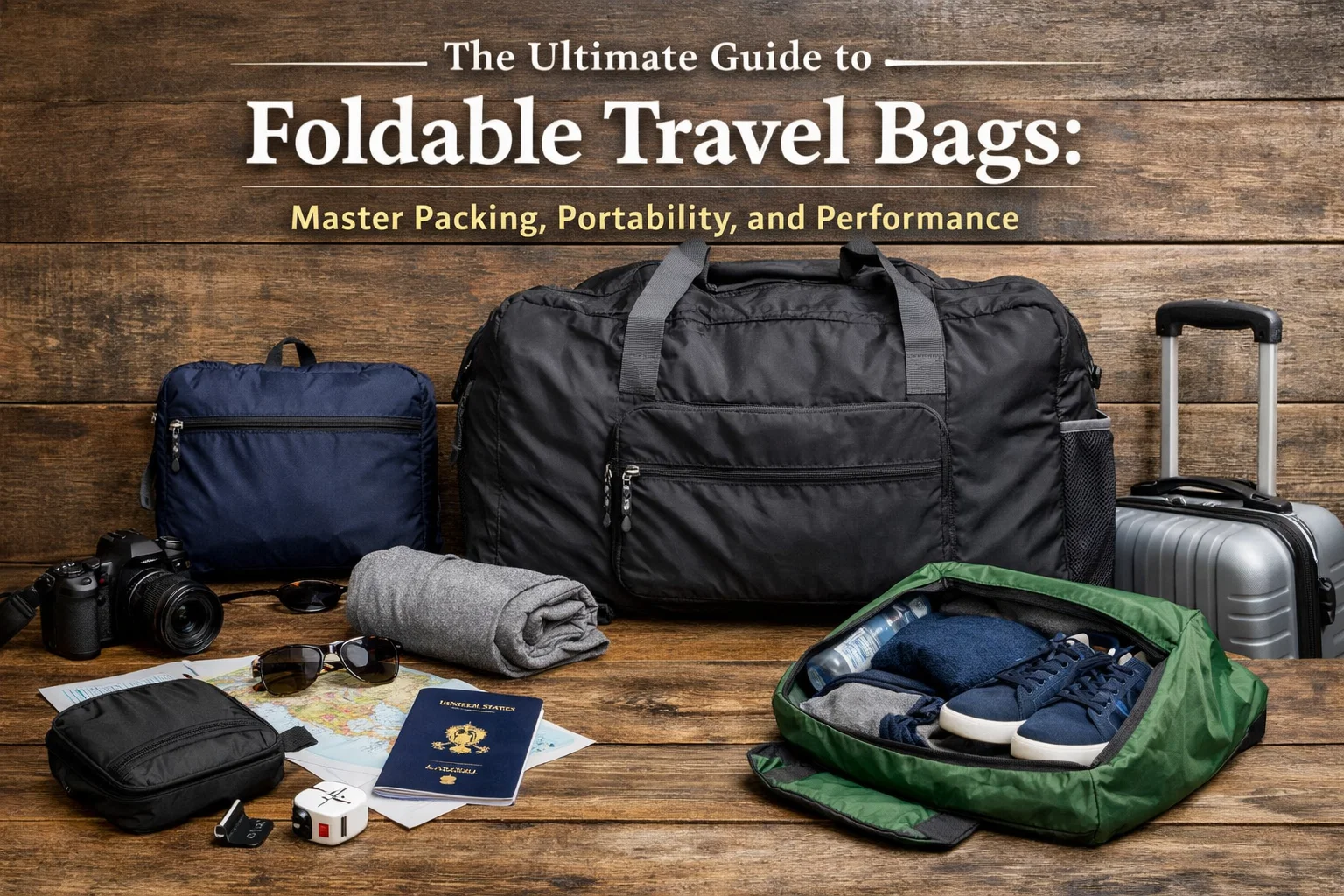
Beyond these, it serves as an ideal dirty laundry separator, a wet bag for swimwear, an impromptu grocery tote, or a secure day bag in areas where you’d prefer not to use a flashy backpack. Its versatility is its superpower.
Key Takeaway: A foldable travel bag is a strategic tool that solves specific problems like souvenir overflow, multi-destination gear management, and overpacking anxiety, transforming potential travel headaches into moments of prepared ease.
Deconstructing the Anatomy: Materials, Features, and Form Factors
Not all foldable bags are created equal. Their performance, durability, and suitability are determined by a combination of construction choices. Understanding these elements is key to selecting a bag that aligns with your travel style.
Materials and Fabric Technology: The heart of any foldable packable bag is its fabric.
- Ripstop Nylon: The gold standard for most high-quality options. It’s incredibly lightweight, strong, and resistant to tearing (the grid pattern stops small rips from propagating). It often has a water-resistant coating or laminate. Look for denier (D) ratings—a higher number (e.g., 70D) indicates a thicker, more durable fabric, while a lower number (e.g., 20D) is lighter and more packable but less abrasion-resistant.
- Polyester: Often more affordable and can be just as durable. It may be less supple than nylon and can have different water resistance properties. It’s common in many reliable mid-range bags.
- Ultra-Lightweight Silnylon or Polyurethane-Coated Fabrics: Used in the most packable (often pouch-sized) options. These compress to near nothing but can be less comfortable to carry under heavy loads and may lack structure.
- Recycled Materials: An increasingly popular and responsible choice, with many brands offering high-performance bags made from post-consumer recycled plastics. Don’t assume recycled means less durable; the technology has advanced significantly.
Critical Features to Scrutinize:
- Zippers: They are a major point of failure. Look for quality, self-repairing coil zippers or sturdy tooth zippers. YKK is a renowned brand synonymous with reliability. Water-resistant aquaguard zippers are a bonus in wet climates.
- Seams: Flat-felled or double-stitched seams are signs of quality construction, distributing stress more evenly and preventing unraveling.
- Straps: For backpacks, padded, contoured shoulder straps make a world of difference if you’ll carry it for more than a few minutes. Sternum straps add stability. For duffels, a detachable, padded cross-body strap is far superior to basic hand-carry loops.
- Structure: Some bags are purely sacks. Others incorporate lightweight foam in the back panel or base to provide comfort and shape. Semi-structured bags are often worth the minor extra bulk for carrying comfort.
- Organization: Does it have a simple main compartment, or does it include external zippered pockets, internal sleeves, or laptop compartments? More organization adds utility but also weight and complexity.
Form Factors: Choosing Your Travel Companion
Each shape serves a distinct purpose. The table below outlines the core strengths and ideal use cases for the primary form factors.
| Form Factor | Primary Strengths | Ideal For | Common Compromise |
|---|---|---|---|
| Foldable Backpack | Hands-free carrying, weight distribution, everyday usability. | Day trips, hiking, use as a personal item on planes, tech carry. | May be less packable than a sack; straps can be less padded. |
| Foldable Duffel/Tote | Maximum volume for size, easy loading/unloading, often stylish. | Souvenir hauling, gym/beach bag, primary overflow luggage. | Can be uncomfortable to carry fully loaded over distance. |
| Foldable Tote Bag | Ultra-lightweight, quick deployment, often chic design. | Market runs, casual day use, an extra shopping bag. | Minimal structure, thin straps limit heavy loads. |
| Foldable Gear Sack | Simple, rugged, highly compressible. | Isolating dirty/wet gear, compressing bulky items like jackets. | Single compartment, limited carrying options. |
In practice, the choice often comes down to a trade-off between packability and comfort. The bag that folds into the tiniest self-contained pouch will likely have the thinnest straps. As one seasoned travel gear consultant notes, “The best foldable bag is the one you forget you’re carrying until you desperately need it. That balance between invisibility in your pack and capability in your hands is the design holy grail.”
Key Takeaway: Your choice should be guided by material durability, thoughtful features like quality zippers and straps, and a form factor that matches your most frequent travel needs, whether that’s hands-free exploring or bulk hauling.
The Art of Selection: Matching a Bag to Your Travel DNA
With the anatomy understood, the next step is introspection. Your ideal packable luggage is an extension of your travel personality. Asking the right questions will lead you to the perfect match.
Assess Your Primary Travel Style:
- The Urban Explorer: Navigating cities, museums, and cafes. You prioritize a blend of functionality and style. A foldable tote bag or a sleek, minimalist foldable backpack with a discreet profile is ideal. Look for materials that resist light rain and pickpockets (like RF-blocking pockets) and a design that transitions from day to evening.
- The Adventure Seeker: Your travels involve trails, boats, or unpredictable weather. Durability and utility are paramount. A rugged foldable backpack with padded straps, a semi-structured back, and excellent water resistance is key. A gear sack is also invaluable for isolating wet hiking boots or a sandy wetsuit.
- The Souvenir Collector/Shopaholic: You know you’ll return with more than you left with. Your focus is on maximum, reliable volume. A sturdy foldable duffel bag with robust zippers and a comfortable cross-body strap is your workhorse. Prioritize high-denier fabrics and simple, cavernous designs.
- The One-Bag Travel Purist: You live by the creed of carry-on only. Your foldable bag is a sacred contingency tool, used only when absolutely necessary. You need the absolute most packability. An ultra-lightweight stuff sack backpack or a tote that compresses to the size of a tennis ball is perfect, sacrificing some comfort for maximum space savings in your primary bag.
Consider the Technical Specs in Context:
- Volume (Liters): 20L is a standard daypack size. 30-40L is a capable overnight or major shopping duffel. 60L+ is for serious hauling, often replacing a checked bag.
- Weight: A few ounces may not seem like much, but for the one-bag traveler, every gram counts. Compare the packed weight of your finalists.
- Packaged Size: How small does it really fold? Look for real-world dimensions, not just “fits in your palm.”
A Real-World Example: Sarah, a photographer, travels with a carry-on roller for her clothes and a dedicated camera backpack. She packs an ultralight 20L foldable daypack. During city explorations, she transfers her daily photography essentials into the foldable backpack, leaving her bulky, expensive camera bag locked in her hotel. The foldable is comfortable enough for all-day wear, discreet, and if it gets dirty or worn, it’s easily replaceable. It solves her need for a secure, comfortable day bag without requiring her to bring a second dedicated, bulky backpack on the trip.
Key Takeaway: Selecting the right foldable bag is a personal equation balancing your dominant travel style, specific anticipated needs, and a honest assessment of which technical specifications (volume, weight, packed size) will serve those needs best.
Masterful Packing and Deployment Strategies
Owning a foldable carry-on bag is only half the battle; knowing how and when to deploy it is the other. This is where strategy turns gear into genius.
Packing the Empty Bag: The First Move. Your foldable bag should be one of the first items you place in your main luggage. Tuck it into a mesh pocket, lay it flat along the lid, or stuff it into the foot of a backpack. The goal is to place it where it takes up “dead space” that wouldn’t be used by other items anyway. In a suitcase, this is often the curved, empty space created by the hard shell. In a backpack, it can be rolled and placed in the hydration sleeve or bottom compartment.
The Modular Packing Method: As mentioned earlier, use your foldable as a dedicated pod for a specific category of items. This could be:
- All electronics and cables.
- A complete “change of climate” outfit (e.g., your entire beach kit).
- Your in-flight essentials (neck pillow, tablet, snacks).
When you reach your destination, you can extract this entire pod without disturbing the rest of your packing. This is exceptionally useful for business travelers who need quick access to a presentation kit or parents packing a separate “kids’ entertainment” module.
The Strategic Deployment: When to Unleash It. Have a trigger. Common deployment triggers are:
- The 75% Rule: When your primary bag reaches 75% capacity, deploy the foldable for dirty laundry. This keeps clean and soiled clothes separate and frees up space in your main bag.
- The Major Purchase: Upon buying a significant souvenir, immediately transfer less essential or bulkier items from your main bag (like a packed jacket or shoes) into the foldable to make protective, padded space for the new item in your primary luggage.
- The Activity Shift: As in the multi-destination example, deploy it when your activity fundamentally changes.
Packing the Full Foldable Bag for Return: This is critical. A floppy, overstuffed duffel is miserable to carry. Pack it with care:
- Place heavy, dense items at the bottom and close to the side that will be against your body if it’s a backpack.
- Use clothing to wrap and cushion fragile items.
- If it has compression straps, use them to create a manageable, balanced load.
- Consider the weight distribution if you’ll be carrying it as a personal item—airlines rarely weigh them, but your shoulders will thank you for a balanced pack.
Key Takeaway: Proactively pack your foldable bag empty in wasted space, use it as a modular packing pod, deploy it based on clear triggers, and pack it thoughtfully when full to transform it from a spare sack into an intelligent travel system.
Navigating Airline Regulations and Travel Logistics
A major advantage of the foldable packable duffel is its utility within the complex web of airline baggage policies. Used astutely, it can save you money and hassle.
The Personal Item Expansion Trick: Most airlines (especially budget carriers) are strict about carry-on size and weight but often allow a “personal item” (purse, laptop bag, small backpack) for free. On your outbound journey, your primary bag is your carry-on, and your empty foldable, packed inside, is invisible. On the return, if your primary bag is now overweight or you have overflow, you can check it (sometimes cheaper than an overweight fee). You then deploy your foldable bag, filling it with the heaviest items from your checked bag (electronics, books) and valuables, and carry it on as your new personal item. This re-shuffling can keep you within limits and protect important gear.
Understanding Weight and Size Limits: Always check your airline’s specific policy for carry-on and personal item dimensions. Your deployed foldable must comply if you intend to use it in-cabin. A common personal item limit is roughly 18″ x 14″ x 8″. Many foldable travel backpacks are designed specifically to fit under the seat.
International Considerations: Be mindful of customs regulations. Returning with an entirely new, full bag of goods could potentially raise questions about declarations. It’s always wise to keep receipts for major purchases. The foldable bag itself is not an issue; it’s the contents that matter.
Security and Peace of Mind: When using your foldable as a daypack in crowded areas, consider its security features. Does it have lockable zippers? Are the pockets secure against pickpockets? Some bags offer slash-resistant fabric or hidden pockets. These features add minimal weight but significant peace of mind in certain destinations.
Key Takeaway: Use your foldable bag as a dynamic tool to navigate airline baggage policies strategically, shifting weight between checked and carry-on luggage to avoid fees and keep valuables with you, always within the bounds of airline size regulations.
Care, Maintenance, and Longevity
A quality foldable travel bag is an investment. With proper care, it can last for hundreds of trips. The maintenance routine is simple but impactful.
Cleaning: Never machine wash or dry unless the manufacturer explicitly states it’s safe. The agitation and heat can degrade coatings, melt adhesives, and distort lightweight fabrics. The correct method is:
- Empty all pockets.
- Use a soft brush or cloth to remove loose dirt.
- Prepare a lukewarm solution of mild soap (like Nikwax Tech Wash or a gentle dish soap).
- Wipe down the interior and exterior with a soft cloth or sponge dipped in the solution.
- Rinse thoroughly with a clean, damp cloth to remove soap residue.
- Hang to air dry completely, away from direct heat or sunlight. Ensure it’s fully dry before storing to prevent mildew.
Storage: The cardinal sin is storing it folded or packed in its pouch for extended periods. The constant tension on the folds and fabric can create permanent weak points. After your trip and once it’s clean and dry, unfold it completely. Hang it in a closet or lay it flat in a drawer. Store it loosely and without tension. The self-stuff pouch is for travel convenience, not long-term storage.
Repairs: Small rips in ripstop fabric can often be repaired with a simple patch kit or tenacious tape from the inside. Loose stitches can be re-sewn. For broken zippers or major seam failures, consider sending it to the manufacturer if they offer repairs, or to a specialist luggage repair shop. The ethos of repairing rather than replacing aligns perfectly with the sustainable nature of a well-made travel tool.
Key Takeaway: Extend your bag’s life dramatically by hand-cleaning it with care, storing it unfolded and relaxed, and addressing minor repairs promptly to prevent them from becoming major failures.
Beyond Travel: The Everyday Utility of Your Foldable Bag
The utility of a great foldable bag doesn’t vanish when you return home. Its virtues of compressibility and readiness make it a surprisingly useful everyday object.
The Emergency “Go Bag” Component: Stash one in your car. It can become an impromptu grocery bag, a carry-all for sports gear, a place for roadside emergency supplies, or a way to bring an unexpected purchase home.
The Gym and Sports Companion: Its lightweight nature and easy cleaning make it perfect for gym clothes, swimming gear, or as a separate compartment for sweaty post-workout attire in your main gym bag.
The Organizational Hero at Home: Use different colored or styled foldables for organizing seasonal clothing, hobby supplies, or donation items. They breathe, are easy to label, and can be stacked or stored neatly.
The Always-Ready Tote: Keep a chic foldable tote bag in your everyday purse or briefcase. You’ll never need a disposable plastic bag for an unplanned stop at the farmers’ market or bookstore again. This simple habit is a powerful step toward reducing single-use plastic consumption.
This transition from specialized travel tool to integrated life tool is what separates a frequently used item from one that gathers dust. It justifies the investment and reinforces the design intelligence behind a simple, adaptable piece of gear.
Key Takeaway: Maximize your investment by integrating your foldable bag into daily life as a gym bag, emergency kit, organizational tool, or permanent reusable shopping tote, proving its value far beyond the airport.
The Final Checklist: Your Pre-Purchase and Pre-Trip Guide
Before you buy and before you depart, run through this actionable checklist to ensure you’ve made the optimal choice and are prepared to use it effectively.
Pre-Purchase Selection Checklist:
- [ ] Identify Primary Use: Souvenir hauler, daypack, gear separator, or emergency backup?
- [ ] Choose Form Factor: Backpack, duffel, tote, or gear sack based on that use.
- [ ] Evaluate Material: Seek durable ripstop nylon or polyester (consider denier).
- [ ] Inspect Features: Quality zippers (YKK), comfortable straps, desired organization.
- [ ] Check Packed Size & Weight: Does it fit your “invisible” packing philosophy?
- [ ] Assess Volume: 20L for day use, 30-40L+ for major overflow.
- [ ] Consider Security: Are lockable zippers or hidden pockets needed?
- [ ] Read Verified Reviews: Look for comments on long-term durability, not just unboxing.
Pre-Trip Deployment Preparedness Checklist:
- [ ] Packed Empty: Is it tucked into dead space in your primary luggage?
- [ ] Deployment Trigger Defined: What event will prompt you to use it (laundry, shopping)?
- [ ] Weight Strategy Planned: Know which heavy items could transfer to it for airline compliance.
- [ ] Security Aware: If using as a daypack, understand its vulnerability and use precautions.
- [ ] Home Base Ready: Have a plan for its storage (unfolded) when you return.
Conclusion: Embracing a Smarter Way to Travel
The journey through the world of the foldable travel bag reveals it to be far more than an accessory. It is a paradigm shift in how we approach packing and mobility. It represents preparedness without penalty, freedom without frivolity. It answers the modern traveler’s desire for simplicity, adaptability, and conscientious consumption.
From its technical construction in ripstop nylon to its strategic role in bypassing baggage fees, from its humble beginnings as a stuff sack to its current status as a design-centric, multi-functional tool, the foldable bag has earned its place in the savvy traveler’s kit. It solves tangible problems—the panic of an overflowing suitcase, the discomfort of a poorly packed daypack, the waste of a disposable bag—with elegant, repeatable solutions.
By applying the insights in this guide—selecting based on your travel DNA, deploying with strategy, and caring for your bag with intention—you elevate a simple piece of gear into a trusted travel companion. You move from being a passenger to being a prepared explorer, ready for whatever the journey brings, knowing you have the capacity, both literal and figurative, to handle it with ease. So, on your next adventure, pack your curiosity, your sense of wonder, and a well-chosen foldable bag. The space it saves in your closet is trivial compared to the peace of mind and practical freedom it will create in your travels.
Frequently Asked Questions
What is the main advantage of a foldable travel bag over a regular bag?
The paramount advantage is its dual-state nature. When empty, it compresses into a negligible package, allowing you to carry a “spare” bag without sacrificing space. When deployed, it provides full, immediate carrying capacity for souvenirs, laundry, or gear separation, offering unmatched flexibility without the bulk of a second full-sized suitcase.
Can a foldable backpack be comfortable for all-day use?
Yes, but you must choose carefully. Look for models with padded, contoured shoulder straps, a semi-structured or foam-padded back panel, and a sternum strap. While they may not match the ergonomics of a dedicated hiking pack, high-quality foldable daypacks are designed specifically for comfort during extended wear, making them perfectly suitable for city touring or light trails.
How do I prevent my foldable bag from getting damaged?
Avoid overloading it beyond its intended capacity, as this stresses seams and zippers. Keep sharp objects away from the thin interior lining. Most importantly, never store it long-term in its packed pouch; always unfold and hang it after use to prevent permanent creasing and fabric fatigue that can lead to tears.
Are foldable bags waterproof?
Most are water-resistant, meaning they will shed light rain or splashes for a short time. Few are fully waterproof (submersible) unless specifically designed as such (like a dry bag). For critical electronics in a downpour, use a separate dry sack or zip-lock bag inside your foldable backpack for absolute protection.
What should I look for in a foldable bag for heavy-duty use?
Prioritize high-denier fabric (e.g., 70D or higher ripstop nylon), robust, self-repairing zippers (like YKK #5 or higher), double or bar-tacked stitching at stress points, and padded, wide carrying straps. A semi-rigid base panel can also help a duffel maintain shape and protect contents when heavily loaded.