The Family Travel Wallet: Your Essential Hub for Organized and Secure Journeys
For families, travel is an investment in lifelong memories. But between boarding passes, foreign currency, emergency contact lists, and a dozen snack receipts, the logistics can feel like a tax on your joy. The chaos of a scattered purse or overstuffed pocket undermines the very freedom you seek. This is where the concept of the family travel wallet transforms from a simple accessory into a critical command center. It is the physical and psychological anchor for your entire trip, designed to corral the unique blend of documents, funds, and vital information that a family on the move accumulates. This guide explains not just what a family travel wallet is, but how to choose, use, and master it as a strategic tool for smoother, safer, and more enjoyable adventures.
This resource helps readers move beyond generic travel tips to solve the specific, tangible problems of traveling with children. We will explore how the right organizational system protects against loss, reduces friction at critical checkpoints, and even mitigates minor crises. From assessing durability and RFID security to implementing clever organization hacks for passports and health cards, this is a comprehensive manual for anyone who believes that the journey should be as rewarding as the destination. We’ll cover the tactical, the practical, and the strategic, ensuring you finish with a clear action plan for your next big trip.
Understanding the Core Function of a Family Command Center
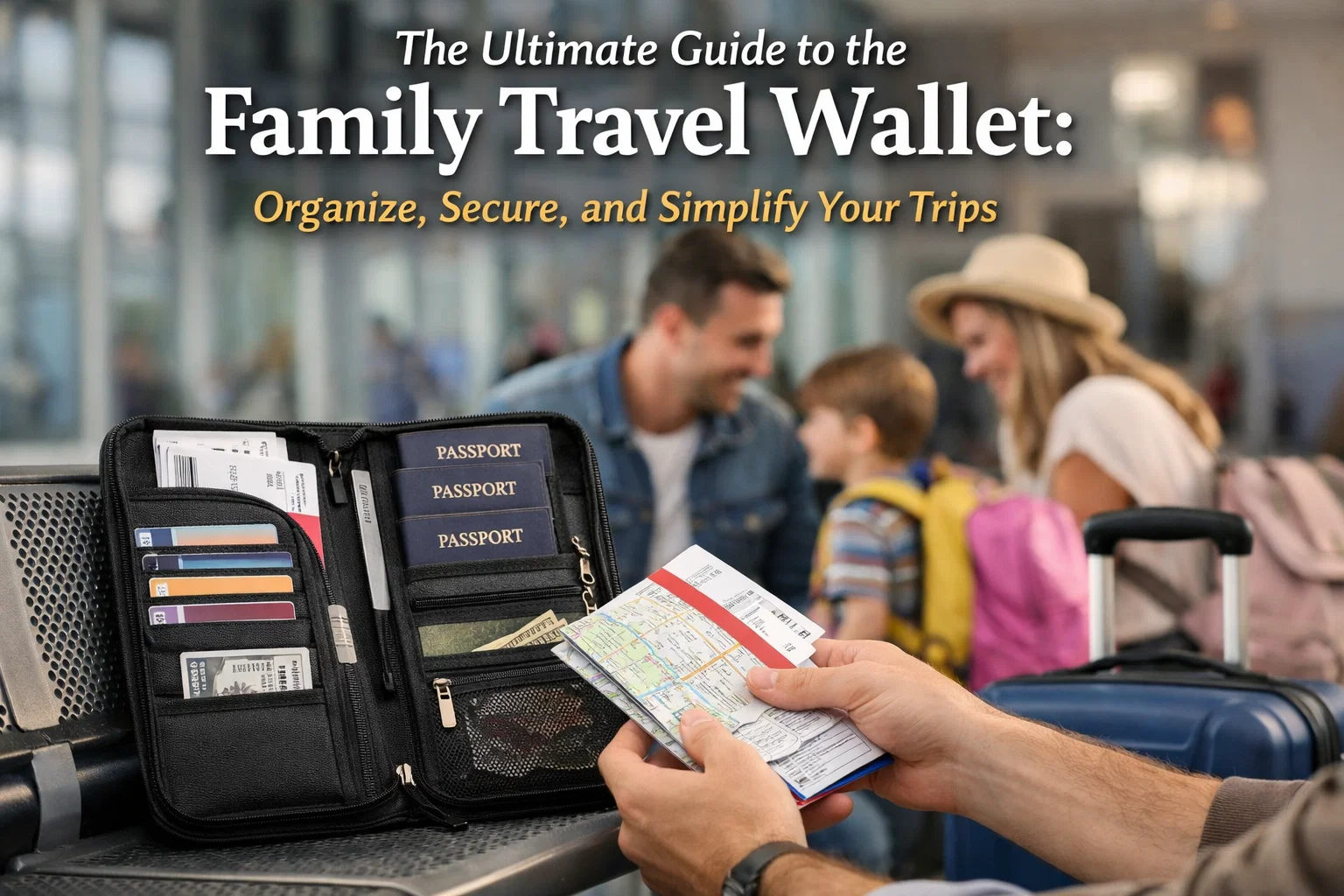
At its simplest, a wallet holds money. A travel wallet might add a passport slot. But a true family travel wallet is a different category altogether. It is a consolidated, secure, and intelligently compartmentalized holder for every critical item required to move a group of people—each with their own needs and documents—through various stages of a journey. Its primary function is not storage, but rapid retrieval and systematic organization under pressure.
Think of the last time you stood at a crowded airline counter or a busy immigration desk. The request comes: “Passports and boarding passes for everyone, please.” Without a system, this triggers a panicked dig through backpacks, jacket pockets, and your partner’s carry-on. A dedicated family travel wallet turns that stressful scramble into a simple, confident presentation. Every document has a pre-assigned place. This shift from reactive searching to proactive management is profound. It reduces group anxiety, speeds you through formalities, and sets a tone of calm control that children subtly absorb. The wallet becomes the single source of truth for your trip’s logistics.
In practice, the best family travel wallets solve three immediate user problems: the fear of losing a vital document in transit, the frustration of wasting precious vacation time hunting for items, and the vulnerability of having valuables scattered across multiple, less secure locations.
Core Takeaway: A family travel wallet’s highest value is as an organizational command center that enables quick, stress-free access to all essential travel documents for your entire group.
The Critical Evolution: From Pocket Wallet to Family Logistics Hub
The journey to the modern family travel wallet is a story of adapting to changing travel realities. A generation ago, a father’s leather bifold and a mother’s purse might have sufficed. Travel was less frequent, documentation was simpler (often just tickets and IDs), and security concerns were different. The pocket wallet was designed for a single individual’s daily needs.
The shift began with the convergence of several factors. Increased international family travel introduced passports and visas as common documents. The rise of digital boarding passes created a new category of “critical but intangible” items that still needed a physical backup. Heightened awareness of digital theft spurred the need for RFID-blocking technology. Simultaneously, families began carrying more specialized items: children’s health insurance cards, notarized permission letters for solo parents, allergy action plans, and multiple credit cards designated for specific trip budgets.
The market responded with products that were essentially enlarged personal wallets. These often fell short because they failed to account for the group dynamic. They might hold four passports, but not in a way that allowed you to pull out “child B’s” document without disturbing the others. They lacked space for the odd-shaped items, like a folded paper visa or a sim card holder. The modern, purpose-built family travel wallet has evolved from this feedback loop. It is no longer an accessory but a piece of specialized travel gear, as intentional as choosing the right stroller or suitcase. It acknowledges that family travel logistics are a unique challenge requiring a tailored solution.
Core Takeaway: The family travel wallet has evolved from a simple cash holder into a sophisticated piece of travel gear designed to solve the unique document and security challenges of moving a group.
Anatomy of an Ideal Family Travel Wallet: Features That Matter
Not all travel wallets are created equal. Choosing the right one requires looking beyond aesthetics to the specific features that deliver function under real-world conditions. Here is a breakdown of the non-negotiable and highly desirable components.
Durability and Materials: This wallet will be subjected to more abuse than your everyday one. It will be stuffed into seat-back pockets, jammed into diaper bags, and exposed to sunscreen-smeared hands and spilled juice. Look for materials like ballistic nylon, coated canvas, or full-grain leather. Seams should be double-stitched or bonded, and zippers should be high-quality like YKK. A water-resistant or waterproof material is a major advantage, protecting contents from a sudden downpour or a tipped water bottle.
RFID-Blocking Security: This is a near-standard requirement today. RFID (Radio-Frequency Identification) blocking is a layer of material, typically a metal mesh, that prevents unauthorized scanning of the chips in modern passports, credit cards, and driver’s licenses. While the risk of “digital pickpocketing” is sometimes debated, for a family travel wallet, the inclusion is a prudent, low-cost insurance policy. Ensure the wallet specifies that all card and document slots are fully shielded.
Compartmentalization and Capacity: This is the heart of the design. An effective wallet must have clear, dedicated spaces for:
- Passports: Individual slots for at least four, preferably with a cover flap or elastic to keep them securely closed.
- Boarding Passes: A long, flat sleeve that can accommodate a folded paper pass or allow a smartphone to be partially inserted for a digital QR code.
- Currency: Multiple bill compartments are ideal—one for your home currency, one for your destination currency. A separate zippered coin pocket is essential.
- Cards: Ample slots (12-16) for credit, debit, ID, and insurance cards. These should be easy to thumb through.
- Pen Holder: A small loop for a pen is a surprisingly critical feature for filling out customs forms on a plane.
Additional Pragmatic Features: A clear ID window on the exterior can be handy for quick hotel check-in. Some wallets include a detachable wristlet or clutch for when you want to carry just the essentials on a short outing. External pockets for a phone or sunglasses can blur the line between wallet and small purse, which may or may not suit your style.
A travel wallet is a consolidated, secure organizer designed to hold all critical documents, currency, and cards for a traveling family. Its primary purpose is to ensure quick access and protect against loss or theft by keeping essential items in one dedicated, often RFID-blocking, location. Moving beyond a simple holder, it functions as a logistical hub for group travel.
Core Takeaway: Prioritize durable materials, verified RFID protection, and intelligent compartmentalization over style when selecting a wallet that must perform under travel stress.
Strategic Organization: The Methodology Behind the Madness
Owning a sophisticated family travel wallet is only half the battle. How you pack and organize it is what unlocks its true potential. A haphazard approach negates all the benefits of the design. The goal is to implement a system so intuitive that any responsible adult in your group could find any needed item in seconds, even in low light or a stressful situation.
Start with a dedicated spot for each family member. Assign specific passport slots in a logical order (e.g., parents first, then children by age). Use card slots consistently: perhaps one column for credit cards, another for IDs and driver’s licenses, and a third for health insurance and membership cards. Currency should be sorted immediately upon exchange; keep larger bills separate from smaller, frequently used notes.
The ”Do Not Remove” rule is paramount. Certain items live in the travel wallet for the duration of the trip and are never transferred to a pocket or daily purse. These typically include: all passports, backup credit/debit cards, the primary health insurance card, and a significant portion of your local currency reserve. The wallet is their home base. For daily spending, you “check out” a single credit card and a small amount of cash, returning them at the end of the day. This minimizes exposure and ensures you always have a secure stash.
Consider including a master information sheet. This is a single piece of paper, tucked into a flat pocket, with: all passport numbers and expiration dates, emergency embassy/consulate contacts, travel insurance policy numbers, and the international customer service numbers for your credit card banks. If the wallet is ever lost and recovered, this information is invaluable to a good Samaritan. It also saves you from digging through emails in a crisis.
Commonly seen in real projects, the most organized travelers also use color-coded dots or bands on passports and corresponding cards. A small green dot on mom’s passport and her credit card, a blue dot on dad’s, etc., makes visual identification instantaneous, especially when handing documents to officials.
Core Takeaway: Implement a strict, consistent organization system within your wallet, treating it as a secure archive for vital documents and a daily hub for spending money.
Addressing Real-World Problems: Loss Prevention, Speed, and Crisis Management
The value of a family travel wallet is most apparent when things go slightly—or terribly—wrong. Let’s examine three common travel nightmares and how this tool provides a solution.
Problem 1: The Scramble at Check-In or Immigration. The scene is universal: a long line, impatient glances, children getting restless. The agent asks for your family’s documents. If they’re dispersed, you perform the “bag rummage,” increasing the risk of dropping something. With a family travel wallet, you have one item to unzip. You present the four passports, already open to the photo page, followed by the boarding passes. The process takes 15 seconds instead of two minutes. You appear competent, reduce stress on the agent (and yourself), and move your family forward efficiently. Solution: The wallet enables rapid, grouped document retrieval, transforming a point of friction into a moment of smooth execution.
Problem 2: The Dreaded “I Lost My Wallet” Moment. A child misplaces their daypack; a pickpocket finds success; a jacket is left on a train. If your cash, cards, and IDs are scattered, this is a catastrophe. With a centralized system, only the “checked out” daily spending money and one card are at risk. The vast majority of your financial assets, all identification, and your ability to continue traveling remain secure in the main family travel wallet, which should be kept in a more protected location (like a hotel safe or a secure cross-body bag). Solution: The wallet acts as a central, secure repository, isolating daily risk and preserving your core travel capabilities.
Problem 3: A Medical Emergency in a Foreign Country. In a panic, you need the child’s health insurance card, your passport for ID, and a credit card with a high limit—immediately. Fumbling through different bags wastes precious time. A well-organized wallet lets you grab the entire unit and go. The information sheet inside has policy numbers and emergency contacts ready for the hospital administrator. Solution: The wallet consolidates critical crisis-response tools, ensuring you can act swiftly and provide necessary documentation without delay.
Core Takeaway: A family travel wallet directly solves major travel pains by preventing loss, accelerating formalities, and providing immediate access to critical documents during emergencies.
The Digital-Physical Hybrid: Integrating Technology with Your Travel Wallet
The modern family travel wallet exists not in a vacuum, but in a hybrid world where digital and physical tools must work in concert. While the wallet is the physical hub, your smartphone is the digital brain. The synergy between them is powerful.
Your wallet carries the physical backup for digital items. Always print paper copies of boarding passes, hotel reservations, and rental car confirmations. Digital systems can fail—phone batteries die, airport Wi-Fi drops, apps crash. Slip these paper backups into your wallet’s boarding pass sleeve. Similarly, while digital copies of passports are wise (stored securely in a cloud service like Dropbox or Google Drive), the physical document is non-negotiable for authorities.
Conversely, use your phone to back up the wallet. Before you leave, take clear, well-lit photos of the open photo page of every passport, every credit card (front and back), and your travel insurance card. Store these in a dedicated, password-protected album. Email these photos to your trusted emergency contact at home. This ensures that if the entire wallet is lost or stolen, you have instant access to all numbers, expiration dates, and customer service lines to facilitate reporting and replacement.
A practical case-style insight involves boarding passes. The most efficient travelers use a hybrid approach: they have the digital boarding pass open on their phone for speed but keep the paper copy folded in the wallet as an absolute backup. When approaching security, they hold the phone in one hand (digital pass ready) and the open wallet in the other (passports and paper pass accessible). This covers all bases seamlessly.
Core Takeaway: Your family travel wallet and smartphone should function as an integrated system, with each providing a backup for the other to ensure resilience against technical or physical failure.
Selecting the Perfect Wallet: A Decision-Making Framework
With countless options on the market, selecting the right wallet can be paralyzing. This decision framework moves beyond features to align the product with your family’s specific travel personality and needs.
| Family Travel Profile | Primary Needs | Recommended Wallet Type | Key Features to Prioritize |
|---|---|---|---|
| The Minimalist Urban Family (City breaks, light packing) | Sleekness, cross-body security, easy access for frequent transactions. | Clutch-style or small folio with a detachable strap. | RFID blocking, 3-4 passport slots, dedicated phone pocket, slim profile. |
| The Adventure Family (Hiking, beaches, variable climates) | Extreme durability, water resistance, sand/dirt protection. | Zippered, structured case in ballistic nylon or synthetic material. | Full-wrap zipper, waterproof lining, robust stitching, lanyard loop. |
| The Long-Haul / International Family (Multi-country trips, complex visas) | Maximum capacity, superior organization, long-term durability. | Large, multi-compartment folio or organizer. | 8+ passport slots, multiple currency sections, pen loops, ample card slots. |
| The “Divided & Conquer” Family (Parents who split documents) | Modularity, the ability to separate documents while maintaining security. | A two-part system: a main wallet + a detachable passport holder for each parent. | Interlocking components, individual RFID protection on each piece. |
If you’re deciding between two models, always err on the side of slightly more capacity than you think you need. Travel has a way of generating extra paperwork, receipts, and tickets. The minor increase in bulk is worth the flexibility.
Beyond the table, consider the “grab test.” Can you open it, retrieve a specific passport, and close it with one hand while holding a child’s hand with the other? Test the zippers and closures—they should be smooth but secure. Feel the material; does it seem like it will show stains or wear quickly? These hands-on assessments are as important as the spec sheet.
Core Takeaway: Match your wallet choice to your dominant travel style, prioritizing the features that solve your family’s most frequent pain points, and always test for one-handed operability.
Proactive Security Protocols: Beyond the RFID Blocking
Security is a layered endeavor. The RFID-blocking feature of your family travel wallet is just the first layer. True security comes from a protocol of how you carry, use, and store the wallet throughout your journey.
Carry Philosophy: The wallet should never be in an open-top bag, a back pocket, or a loosely held purse. It should reside in a zippered compartment of your personal item or carry-on. When you need to access it in public (at a ticket counter, for payment), be mindful of your surroundings. Use your body to block the view of the contents as you open it. The goal is to never advertise what you’re carrying or where you keep it.
The “Decoy” Strategy: Many seasoned travelers employ a decoy. This is a slim, cheap wallet that holds a small amount of local currency (equivalent to $20-40) and an expired credit card or gift card. This is what you carry in your pocket or easy-access bag pocket for daily excursions, market visits, or crowded subway rides. If you are targeted, you can hand over the decoy without resistance. Your true family travel wallet, containing the bulk of your funds and all vital documents, remains secured elsewhere, such as in a hotel safe or a concealed money belt worn under clothing.
Storage Rotation: When in your accommodation, don’t leave the wallet out on a desk. Use the room safe, or if one is unavailable or untrusted, use a portable travel lock to secure it inside your luggage. Some travelers use a diversion safe—an ordinary-looking object like a sunscreen bottle with a hidden compartment. The principle is consistent: out of sight, and ideally, physically locked down.
As a security expert once noted in a travel seminar, “The best security system is the one that avoids the confrontation altogether. Your behavior—how you carry yourself and your valuables—is a stronger deterrent than any lock.”
Core Takeaway: Pair your secure wallet with smart behavioral protocols, including strategic carrying methods and a decoy system, to create multiple layers of defense against theft.
Maintenance, Longevity, and the Post-Trip Reset
A family travel wallet is a workhorse, but it requires care to maintain its functionality and hygiene over many trips. The post-trip reset is a ritual as important as the pre-trip pack.
Upon returning home, empty the wallet completely. Remove every receipt, ticket stub, foreign coin, and scrap of paper. This is the time to sort receipts for expense reports or memory books. Wipe down the interior with a disinfectant wipe or a cloth dampened with a mild soap solution, paying attention to card slots and fabric linings. Let it air dry fully before reassembling.
Inspect it for wear and tear. Are the zippers still smooth? Is any stitching fraying? Is the RFID lining peeling? Addressing minor repairs now prevents a failure during your next trip. For leather wallets, condition the material to prevent cracking.
The reassembly phase is strategic. Leave the “permanent” items in place: your information sheet, a domestic emergency contact card, and perhaps a $20 bill in your home currency as a “just in case” stash. This keeps the wallet trip-ready. Store it with your other core travel gear (luggage tags, adapters), not with your everyday wallets. This habit ensures it’s always prepared for the next adventure and never gets co-opted for daily use, which would defeat its purpose.
From hands-on use, I’ve found that wallets with fewer nooks and crannies are easier to clean and maintain. A simple interior, even if it has high capacity, will stay fresher and more functional over years of use than one with complex, fabric-lined elasticized pockets that trap dust and crumbs.
Core Takeaway: Instituting a thorough post-trip cleaning and inspection routine extends the life of your wallet and ensures it’s always organized and ready for your next journey.
The Psychological Dividend: Reducing Anxiety and Enhancing Presence
The benefits of a family travel wallet extend beyond the tangible into the psychological realm of travel. Chaos and uncertainty are primary sources of anxiety, especially for parents who feel the weight of responsibility for their family’s well-being in an unfamiliar place. The constant low-grade worry of “Where is the passport?” or “Do I have enough cash for this taxi?” acts as a cognitive tax. It drains mental energy and reduces your capacity to be present, to engage with your children, and to absorb the joy of the experience.
A well-implemented system using a dedicated wallet directly alleviates this tax. By externalizing and systematizing the logistics, you free up RAM in your brain. You create what psychologists call “cognitive offloading.” You no longer need to remember which pocket holds which card; the system remembers for you. This creates a profound sense of control. When you know exactly where every critical item is, and have protocols for accessing and securing them, a layer of background stress evaporates.
This calm is contagious. Children are highly attuned to parental anxiety. A flustered, searching parent can trigger insecurity in a child. Conversely, a parent who can calmly and efficiently produce a needed document or solve a minor money issue models competence and reassurance. The family travel wallet, therefore, becomes a tool not just for organization, but for fostering a calmer, more resilient, and more present family travel dynamic. The investment pays dividends in memory quality, not just logistical smoothness.
Core Takeaway: By eliminating the chaos of scattered documents, a family travel wallet reduces collective anxiety, freeing mental space for parents to be more present and engaged with their family and the travel experience itself.
Conclusion: Mastering the Journey Through Masterful Organization
Family travel is one of the greatest gifts we can give ourselves and our children, a tapestry of shared experiences that lasts a lifetime. Yet, the logistics involved can sometimes feel like they overshadow the joy. The family travel wallet is the antidote to this modern travel dilemma. It is far more than a product; it is a philosophy of travel. It represents a commitment to intention over chaos, to security over vulnerability, and to presence over preoccupation.
We have explored this tool from every angle: its evolution, its critical features, the strategic methodology for its use, and its profound impact on both practical problem-solving and family psychology. From choosing the right model for your adventures to implementing layered security protocols and a maintenance ritual, mastering the family travel wallet is a foundational skill for the modern traveling family.
It transforms you from a reactive participant buffeted by the currents of travel formalities into a proactive captain, calmly navigating your family toward the experiences that matter. In the end, the goal is not merely to have a place to put your passports, but to have the peace of mind to fully enjoy the world you’ve come to see, together.
Actionable Family Travel Wallet Checklist
Use this checklist before and during your next trip to implement the strategies outlined in this guide.
Before You Buy:
- [ ] Identify your family’s primary travel style (Minimalist, Adventure, International, etc.).
- [ ] Select a wallet with durable, water-resistant materials and robust zippers/stitching.
- [ ] Confirm the wallet has full RFID-blocking protection for all card and passport slots.
- [ ] Ensure capacity matches your needs (passport slots, card slots, currency sections).
- [ ] Test the “one-handed operability” if possible.
Before You Depart:
- [ ] Designate a specific passport slot for each family member.
- [ ] Assign card slots by category (credit, ID, health).
- [ ] Create and insert a master information sheet with key details and contacts.
- [ ] Take clear digital photos of all passports, cards, and documents. Store them securely and share with an emergency contact.
- [ ] Load the wallet with all vital documents, a pen, and a reserve of home currency.
- [ ] Pack a “decoy” wallet for daily use.
During Your Trip:
- [ ] Enforce the “Do Not Remove” rule for core documents.
- [ ] “Check out” only daily spending cash and one card from the main wallet.
- [ ] Always carry the main wallet in a zippered, secure compartment.
- [ ] Use calm, deliberate motions when accessing the wallet in public.
- [ ] Store the main wallet in a hotel safe or locked luggage when not needed.
Upon Returning Home:
- [ ] Empty the wallet completely of all receipts and foreign currency.
- [ ] Wipe down and clean the interior thoroughly.
- [ ] Inspect for any wear and perform minor repairs if needed.
- [ ] Re-stock with permanent items (info sheet, emergency cash).
- [ ] Store the wallet with your core travel gear.
Frequently Asked Questions (FAQs)
What exactly is a family travel wallet?
A family travel wallet is a purpose-built organizer designed to hold and protect all essential documents, currencies, and cards for an entire traveling family. Unlike a personal wallet, it features multiple passport slots, ample card capacity, and often RFID-blocking technology. Its core function is to consolidate items for quick access and enhanced security, reducing stress and preventing loss during group travel.
Is RFID blocking really necessary for a travel wallet?
While the actual incidence of digital pickpocketing is debated, the inclusion of RFID blocking in a family travel wallet is a prudent, low-cost precaution. It acts as a layer of digital insulation for the chips in your passports and credit cards. Given the high stakes of a family’s travel documents being compromised, it’s considered a standard and worthwhile feature for peace of mind.
How do I organize a wallet for four or more people?
Use a consistent, assigned system. Dedicate specific passport slots to each person (e.g., by age order). Use columns of card slots for different categories: one for parents’ credit cards, one for IDs and driver’s licenses, and one for health insurance cards. Keep currencies separated by type in different compartments. Consider using small color-coded stickers on passports and corresponding cards for instant visual identification.
Can’t I just use a large purse or a ziplock bag instead?
You can, but you sacrifice security, organization, and durability. A purse offers no RFID protection and makes finding specific documents difficult. A ziplock bag lacks structure, damages documents, and screams “tourist” to potential thieves. A dedicated travel wallet is designed for the task, with protective materials, intelligent layout, and a professional appearance that facilitates smoother interactions at checkpoints.
What should I do if my family travel wallet is lost or stolen?
Remain calm and act swiftly. First, use your digital backups (the photos stored on your phone/cloud) to immediately call and cancel all credit cards. Contact local police to file a report. Visit your country’s nearest embassy or consulate with your digital passport copies and any other ID to begin the emergency passport replacement process. Having your information sheet digitized will make these steps significantly faster.